Evolving Tampere

This is the city of Tampere, nicknamed Mansesteri after Manchester because it used to be the industrial capital of Finland. The capital of the second largest region after Helsinki, it’s a thriving city, which had just received its new landmark: a huge tower hotel built next to the old railroad roundhouses by the station.

Back then the station area was seeing huge redevelopment. More and more ambitious projects were planned at that time, including a deck above the rails and a huge multi-purpose arena and high rise apartments on top of that. These are now being built, some are ready, but back when I was sipping my overly expensive latte in the tower, they were still on the drawing board. But just by looking at this view I could see four points of interest. Can you spot them?

The first one was almost lost and forgotten by now. Built as a dorm for tech students in the early 1960’s the 10-storey house also housed several restaurants and other businesses. During my visit it was being demolished along with a neighbouring hotel. They would be replaced by a 21-storey skyskraper.

In the following block I found the old goods station of Tampere. It was built in 1907 and listed as an important landmark, but the city had a problem. They wanted to preserve the building, but it was in the wrong place and made traffic in the area pretty difficult.

On the opposite side of the road was Morkku, the old house of railroad workers. It, too, was deemed historically important, but then someone came up with a plan: let’s demolish Morkku, let’s move the goods station in its place across the road and then build the new road. Some people thought this was too expensive, wanted to demolish the goods station and preserve Morkku instead.

This was debated back and forth for years, but finally the goods station won. Morkku was demolished in the Spring of 2020 and the railway statio (or actually the outer walls of it) was moved in the summer. It was the first successfully moved brick building in Finland, and a documentary of the move can be seen here.

The final intersting place was an indifferent yellow wooden house from the 50’s, which was demolished a few months later. I gained access to none of the places, some of which I never saw again.

But although I didn’t explore anything, a new idea came up: why not look up several locations in another town and do a weekend trip there to do some urbexing.

Just Another Day at the Office

It was a Thursday afternoon, shortly before 4 pm. I had had another tight day at work, but had started early, so I was also allowed to escape early. When leaving work, I noticed something was different, so I decided to take a detour.

This building was a part of the headquarters of newspaper Kaleva. Originally built in the mid 1960’s, the complex featured the editorial and commercial offices of the newspaper and a printing press.

In the early 1980’s the compex was enlarged. The company bought a new, much larger printing press and built a larger printing house for it. The printing company became a subsidary, broadened its operations to other prints than newspapers and an office wing was added. And now somebody had driven an excavator right through the wall of this 80’s annex.

Of course we knew this was coming. Technology developed, and the printing press and editorial offices were no longer needed in the same building. A new press was bought, a new printhouse was built outside town and the entire 80’s annex was abandoned. The whole premises including the original 60’s headquarters building was sold to property developers, who planned to demolish everything and build around a dozen blocks of flats on the site. So, what’s with all the fuss, then?
Well, I worked in this building.

Right that morning I had walked in through the main entrance, and while I was doing my job, they had started the demolition without anybody noticing anything special.

I decided to bike past the printing house every day after work to document the progress, and I have to say, that they progressed pretty quickly with the demolition. This picture was taken the following Monday.

Tuesday. Here you can see the looks of the concrete built printing house.

I have to say, that this part of the building was really not a loss.

They had at least three excavators working on the site.

This sight made me a bit sad. After all, I had been to this complex almost every day during the four years the annex had stood abandoned, and I had never given a thought to exploring it despite having keys there.

Fast forward to the following day, another section of wall had vanished.

Although this section of the complex was around 20 years younger than the original part, it looked very much the same, both from the inside and the outside.

Another day has passed, another section has vanished.

What used to be our parking lot was now a scrapyard.

The following day they had almost managed to cut the printing house in half.

Around half of the office wing was gone, too.

I actually walked through those halls before they were abandoned. The company gym was in the basement, which is no more.

The end of the building seen in the second photo of this post had shrunk quite a bit.

The following tuesday the printing hall was down.

And not much of the office building remained either. Notice the sky blue elevator doors.

The following saturday they had finally broken through the printing house.

Most of the office wing was also gone by now.

They had also advanced in the end. Wonder, where the huge neon sign went.

A day later they had again advanced.

The end was still standing, though. It looks as though a lot of it still remains, but that isn’t exactly the case.

The southeastern corner of the office wing still stands.

Compare this with the second picture of this post.

By the end of July most of the place was gone.

And by early August all that was left was the former printing hall and the old headquarters on the right, where I still continued to work daily.

Anticipating Changes

Just another hardworking excavator performing its daily duty? Yes and no.

This petrol station had opened in 1959, and for 57 years it had served cars and drivers. The building was original despite small facelifts being done, and it was probably one of the oldest petrol stations still in operation in Oulu and the whole of Finland.

In March it was announced, that the place would close down, and the last drop of petrol was refuelled here just before Midsummer. The place stood empty for less than two weeks and in early July it was already being reduced to rubble.

So what, just another old building?

Yes. But this one was demolished, because an underpass for bikers and pedestrians would replace it. And guess, what was on the other side of the road?

Well, I’ll tell you. The empty modernist villa with the creepy ever changing writings on the wall I had explored so many times. The countdown to the destruction of one of my all time favourite exploration targets had started.

A Cabin in the Woods

Long bike trips were a thing for me that summer. And while biking in the suburbs, I was always on the lookout for new abandoned houses. Somewhere on the outskirts of the suburb Kaakkuri I spotted this tiny cottage, which most definitely seemed abandoned. The day was beautiful, and there were a lot of people outside, so I couldn’t sneak in.

I biked on and did my usual tour. There was a tiny yellow house in Heikkilänkangas, which had been abandoned for a longer time. In recent months it had started to become more and more vandalized, and furniture was oll over the yard.

I tried to enter it several times. There was only one neighbouring house, and its inhabitants seemed to be on their yard every single time I attempted an entry. I never managed to get inside before the place burned down the following year.

But at the end of my tour I returned to Kaakkuri.

Yes, the first cottage definitely was abandoned, but it also seemed quite unsafe. The roof of the veranda was a bit too airy for me, so I decided to take a tour around the place.

The place was mainly used as a storage. Inside were bikes, car tires and furniture all piled on top of each other.

The walls were in a desperate need for paint.

I was right about having second thoughts of entering. The roof had given in and a risk of collapse was real.

The contents of the house didn’t look worth the risk, so I just photographed through the windows this time.

That’s all, folks.

As some of you might have noticed, I sometimes reveal the location of the buildings, sometimes I don’t. If the buildings are still abandoned, I never tell where they are. If they have been demolished or renovated, it doesn’t matter anymore.

So as the location of this place was told in the beginning, the place is no more. I don’t know when it vanished, but in the latest satellite images it is gone. Rest in pieces, wherever you are now, tiny cottage.

Fresh Brew Part II

We explored all floors of the building, but the higher up we got, the more difficult it was becoming to breathe. The windows upstairs were intact, and the air changed less. The large glass windows let in a lot of heat and the air was extremely humid. It was almost as if we were in a greenhouse.

To make matters worse, the walls were growing mould, and the smell was pretty intense. It was mixed with a strong odour of old malt.

More mysterious machinery.

The machines occupied the full height of the room, but my knowledge on brewing beer is so narrow, I have no idea of their use. I’m better at drinking beer than making it.

Most paint had come off the walls.

I wonder what this place was like to work in. Was the smell of malt as strong as now? Did the machines make a lot of noise? Did you get to taste the beer?

Up here it was difficult to distinguish what was paint and what was pidgeon feces. The smell and heat were becoming unbearable by now.

There were large tanks upstairs.

The tanks were of different shapes and sizes.

You could see pretty far from the top floor. The area where the brewery was located was heavily changing with blocks of flats being built everywhere around it.

New houses on this side were already ready.

There were massive leaks on the roof. Yet this section of the building along with the ones made from bricks on both sides of it and some older wooden buildings were supposed to be preserved. Discussions were made about replacing this 60’s concrete section with a new building of similar size and shape, but things were standing still because the company owning the brewery was bankrupt.

Here we are sneaking back out through the front door next to another nice vintage television. The 60’s part of the factory was the only part of the building we could access, the rest was out of bounds.

The facade from the opposite side of the building.

I tried to enter the other buildings several times, but was unsuccessful. In 2019 the large storage and distribution centre and several newer parts of the brewery were demolished. Three wooden buildings and the red brick buildings on both side of the concrete building still stand and are protected. Parts of the facade of the concrete building were demolished probably to finally remove the machinery inside.

Since then nothing has happened. The brewery stands largely abandoned, and new blocks of flats are being built all around it. Apparently they are investigating, whether the old brick buildings would survive, if the concrete part was demolished.

All pictures from the brewery in the gallery.

Fresh Brew Part I

I was taking a Sunday walk with a friend, when she noticed a large building on the roadside.

“What’s that”, she asked.

“That” was a former brewery. Founded in the mid 19th century it changed ownership several times. The oldest buildings were original, the newest one was the grey concrete building from 1968, which was used for cooking the malt and bottling the beer.

The brewery was sold to a nationwide operating company in the late 60’s and brewing stopped in 1979. After that the company built a large storage and distribution centre on the same lot. The rumour had it, that all machinery used to brew beer was still inside the buildings.

I had tried to gain entrance several times, but doors were always locked. I told this to my friend, who wanted to take a closer look anyway.

“No entrance?” she said and pointed at the main entrance of the concrete building. One of the windows was missing.

The rumour had been true. The huge cooking basins were still there, although badly destroyed. Someone had removed the machinery that very year.

The basins were partly inside the floor. Most above the ground level had been destroyed.

It’s difficult to realize, that the last bottles of beer left this place 37 years ago.

Even the brick structure had been damaged, when someone had removed the brewery equipment.

The windows on the ground floor had been destroyed and covered.

The building contained lots of thrash, which really didn’t belong there.

Above the ground floor was a lot more machinery. It looked very exotic, and I couldn’t really determine what it was used for.

The place didn’t exactly look like an office, but there was some paperwork done. Or if not done, at least stored.

The paperwork has ended up on the floor of the adjacent room.

The floor was covered in cardbord boxes and insulation.

To be continued in part two.

The Writing is on the Wall

And here we are again. Another friend of mine learned about my adventures and wanted to see an abandoned building. The villa happened to be nearby, so we went there.

My previous visit had been around one and a half months ago, so I didn’t expect anything special. I got the surprise of a lifetime.

When we entered, I immediately noticed, that there was something different in the place.

Someone had gotten philosophical here. Beautiful or ugly, you’ll always see your image in the mirror, it says.

Yes, we do. But this time the villa was ready to reveal some of them. The pile of old furniture in the place of the old stairs was still there. But now someone had punched holes in the wall above the pile, which allowed a careful climb upstairs. I was able to explore it for the first time

The kitchen was upstairs, which is not a common feature in Finnish homes. It was as if the downstairs was built for business and entertaining business partners, and the upstairs was the home, and a rather small one.

The writing continued upstairs. But now the intruders had started communicating with each other.

The fireplace was nice, so was the floor. I still think this had been a really beautiful building before falling out of grace.

The guarding eye?

The pool room is underneath the roof. It’s strange, the roof didn’t function as a balcony.

A strange installation.

One of the best places to hide in this place, actually.

I know, that one shouldn’t make assumptions based on handwriting. But the person, who has written these, is most likely a girl.

Things started to get more threathening. One of my favourite text was actually one, I didn’t photograph. Such a wonderful place to die, it read. And the one with the red paint had written a big yes under it.

The bathroom was large. And mostly destroyed.

Even the bathtub was reduced to rubble. You need strong tools to do that, so someone has really let their aggression loose.

The texts were like a game of hide and seek. They were in really random places, and I explored the building much more carefully than usually to find all of them.

This one was pretty smart. In a way the texts were a form of art.

The upstairs hadn’t been cleaned as extensively as the downstairs. There was a lot of thrash and debris here and there.

So my home then.

The finder gets to keep. Someone had found it before me, as it was empty.

Although I have several times admired the class of this house, the wallpaper is awful. It doesn’t go very well together with the greenish floor.

It’s ok, darling.

That, too, is ok, darling.

The texts make the soul of the villa beautiful, yet broken.

I can relate. My adventures really are different.

This time we also gained access to the garage wing for the first time.

Most of the garages were mainly empty. One of them even contained a grease pit for car mainteinance.

Not all doors to the garage were open, but someone had punched holes to walls so they were all accessible. Narnia was a storage of old books and winter sports equipment, but too dark to be properly photographed.

Perhaps the time has come to keep a distance to this building for now and find some different adventures.

Return to the Workers’ Institute Part IV

The layout of the annex building was a bit difficult to grasp. Both floors weren’t entirely built in the same level, and there were dark mazes and strange spaces somewhere in between floors.

Here someone has put in the effort to rip lamps and electric cords off the roof.

There was also the basement, which included loads of documentation from the institute’s years. They were all in one big messy pile, and as water had flooded the basement at some point, were pretty mouldy by now. The basement couldn’t be accessed because of this messy pile.

Even this annex included a small balcony. The other one had more of them, though.

There was even an attic, which was in a similar state of disarray as the basement. I expect to see lots of water damage next autumn.

Find the missing fuse.

Oh, great, a toilet. I did have the urge to, um, well, powder my nose. And I did.

There was a second annex to the western annex built in the eighties. It was pretty small and only housed the kitchen and restaurant.

Someone had celebrated a wedding here. The menu included steak, potatoes, fresh salad, salad from smoked fish, bread and non alcoholic drinks.

Even a Christmas menu was available. As the price is in marks, this must have been made prior to 2002.

The architecture and materials were more modern, but the story was the same: no radiators, no locks, just a mess.

I don’t think I’ll be served Christmas food anymore.

The furniture was a bit of a mismatch.

Even one of the school desks had made its way here.

The space was divided by a curtain, but the other side was just the same. The funny thing was, that this building was attached to the older annex, but there was no door in between. The only way to access the canteen and restaurant was through its own main entrance or through a set of balconies built between the old and new building.

This complex featured a lot of irregular roof shapes.

We took the route outside the building and climbed to the second floor of the old annex. Here there were rooms used for accommodation, probably by the academy students. Their beds didn’t look very comfortable.

The roof of the new restaurant wing was blocking the view.

The curtains were from the 80’s or 90’s. And they were lovely.

I hope nobody tries to sleep there anymore.

Wouldn’t sleep on that either.

Instruction for the people for the last day of their course before leaving the accommodation.

In a strange way these rooms remind me of a dormitory, I visited not so long ago.

Reminds me a lot indeed. But unfortunately this was the end of our journey.

The future of the place was pretty unclear back in 2016. The place was recognized as a local landmark by the museum, but was granted demolition permit back in 2014. The owner intended to build apartments on the site.

The news about the demolition was how I originally found the place, but since then not much had happened – except that the radiators had vanished. Some can be seen in the first pictures I took back in 2014.

Either someone had stolen the radiators and sold them for scrap metal, or the demolition had started from there and ended for some reason. Nothing had been heard of the project since then and just an eerie silence had fallen over it.

We’ll leave the story of this building for now and continue at a later date. Meanwhile, new conquests await.

Return to the Workers’ Institute Part III

Our next stop was the attic of the eastern annex building. It was a long open space, where moving was made difficult by thick channels of ventilation pipes made out of concrete and brick. There was really no proper use for the place. It was just for technical equipment and storing things.

Somehow a thick pile of technic, car and building related magazines had ended up here.

The day grandpa’s tv broke down.

The setup really was fascinating in its own peculiar way.

The chair was placed directly under the window almost like a throne.

The main building seen from the eastern annex. The photo really distorts the perspective. You can see right through the third floor corridor as if it was only very short. It wasn’t.

From the attic we go straight down to the basement, where there was a sauna department. This wasn’t a part of the original building, but a later add-on. I’m sorry for the poor image quality.

There was even a terrace behind the sauna, and you could walk directly to the riverbank through the back door to have a nice refreshing swim.

Even the door seemed like a later addition to the building.

The graffiti in the stairway of the main building had appeared since my previous visit.

We walked through the main building all the way to the western annex.

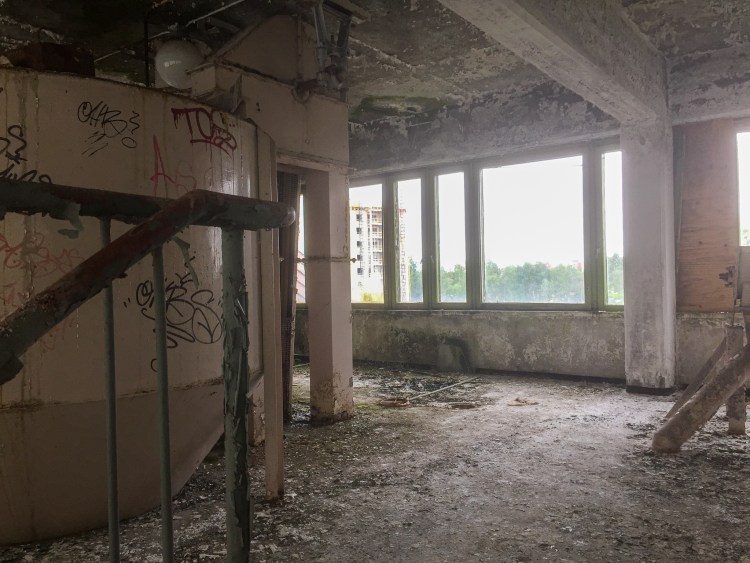
The chaos was even deeper here than in the other parts. There was also much more furniture here.

More than one room contained mattresses in the corner. This seemed to have been a popular place to stay for those, who had no other place to stay.

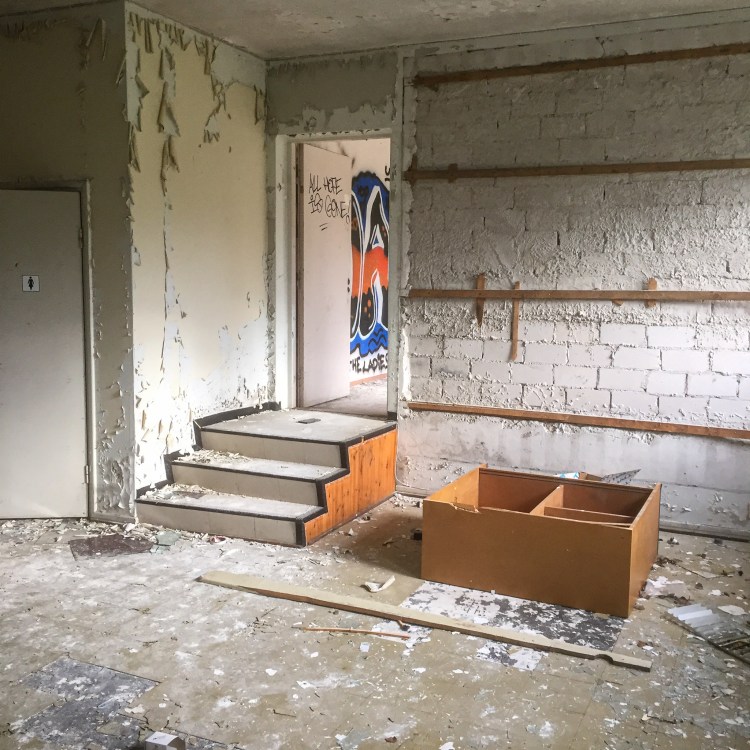
Although the radiators had been removed even in this part of the complex, the rooms hadn’t been emptied. There was lots of school related thrash around

Someone really had wanted to destroy the wall. I wonder, if their success was more about the wall being badly made or the will to destroy.

Apparently the wall wasn’t an original feature of the building, but rather a later addition. I suspect this, because the rooms on both sides of it had a very hig ceiling, which was unique in the complex.

The destruction didn’t limit to the wall. Even the nice parquette had been thrown all around the place.

It looked pretty much the same on the other side of the destroyed wall. Maybe this room was used as a gym in its previous life?

A collection of closets here.

I feel sorry for the neighbours, who are just around 30 metres away. The smashing of windows and blinds must make an awful noise and is usually done during nights. No wonder they have been complaining.

One of the rooms was a small apartment.

There was no proper kitchen, and the place was pretty messy.

The place was full of newspapers, magazines and other mail. And yes, there had really been someone living here.

The room couldn’t really be called a luxury apartment.

This was the tenant’s car insurance bill. This means that he was registered in this address.

School desks and broken windows were a common feature.

Return to the Workers’ Institute Part II

Welcome to the eastern annex. This is about as far as I got during my previous visit.

That was when I spotted a bed in one of the rooms and we backed out. But now this place looks like it hasn’t really served as anybody’s home in a while.

The room looked like some sort of a classroom. Nearby houses can bee seen through the windows.

The back door led straight to the back yard of the neighbours.

The eastern annex was much like the main building. Broken windows, slices of paint and empty rooms.

The lack of radiators was still a strange fact.

A view towards the river from the back.

The blueprints of the building were scattered all around the place.

The first floor of the annex was divided by a curtain door to smaller rooms. They could be made into a larger room.

The rooms looked like they had last been used as offices.

More blueprints. I really find it difficult to determine, which part of the building these are from.

The cupboards were original from the 50’s.

The second floor of the east annex looked like it housed small apartments. For the institute staff, maybe?

The layout upstairs was pretty messy and complex.

The kitchen was largely destroyed. All radiators had been removed, but kitchen appliances were still left.

I’m glad there wasn’t any food in the fridge.

If the floors would have been taken care of, they’d be really beautiful.

The remnants of a kitchen.

And yet they weren’t in a kitchen. The board on the wall looks like this room had rather been an office or a small classroom.

How the kitchen ended up here, we’ll probably never get to know.

The kitchen was in the room next door, and a few elements were indeed missing.

The view really was beautiful. These would have made nice apartments.