An Empty Castle

Towards the end of the year I visited Riga. It wasn’t my first time in the town, and I even managed to book a hotel room from the same side of town as on my previous visit around two years previously.

As I had been here before, I knew all the bars, restaurants, museums and shortcuts to take. I also knew the most beautiful buildings, and there was one very special one that had caught my eye the previous time.

This, I think, was one of the most beautiful buildings in Riga. I remember it being in a very bad shape, but I was surprised how badly time actually had treated it. It looked like it was completely abandoned apart from the business premises.

Built in 1910, Brivibas Iela 88’s history is covered by a Latvian magazine here. According to a Google translation the apartments have been empty since about the fall of the Soviet Union. There are plans to demolish the insides of the block and renovate the building to a five star hotel.

If they come true, I’ll definitely book a visit.

A Sleeping Beauty

Another of my favourite things was taking long bike tours along the river splitting my home town. One of my routes took me through a quiet suburban area, which was rather upper class.

I had been biking the same route for around six years and a small villa had caught my eye. It was darkish brown, built in the early 20th century and was of Jugend style architecture. It had a large yard with a few auxiliary buildings, old apple trees and berry bushes and even a tennis court.

It had been a while since I last passed, and when I came around, I saw something alarming. The once so well kept garden was now slightly overgrown, the windows were dark and empty. I felt sorry for the place.

The villa was definitely uninhabited, but that wasn’t the most alarming part. The trees behind the villa had been hugged, the auxiliary buildings demolished and the tennis court cut in half. There was an excavator and a scaffold behind the building and a brand new house had been built where the forest used to be.

When I got home, I started researching the city detail plan and couldn’t believe my eyes. The plan for the area had been made way back in the early 1980’s. The property was split in three and there was a single family house zoned on each of the plots. The 100 year old villa wasn’t protected in any way.

I started passing by the villa more often to see what would happen with it. One evening I noticed an old person picking berries on the yard. I went to ask what it was all about and they told me that their family member had purchased the property as a plot of land to demolish the villa and build a new house for their family.

What the seller didn’t tell the family member was, that the authorities indeed wanted to protect the building and demolition wouldn’t be that easy. They had already applied for a demolition permit, but it had been rejected. The person told me that the decision would be appealed.

I gave the person my number and asked, if they could contact their family and allow me to photograph inside. They never called me back.

Using Faulty Exhaust as a Guiding Light

In June came the time to take my beloved car to its yearly checkup. Despite its rather high 14 year age, it was in a rather good shape. Or so I thought.

Everything was well, until it was time to check the emissions. At that point the inspector said I had no chance of getting through. There was something way out of order with them.

“Perhaps there’s a leak in the exhaust pipe”, he suggested, checked other systems and finally lifted the car up.

A leak was a little underestimate. The tip of the pipe behind the muffler was almost broken with only around a centimetre holding the thing together.

I called the company usually doing maintainance to my car and told me, that they could only offer to exchanche the whole pipe, which would cost around 500 euros. They told me that it was impossible to obtain just the rear end of the pipe through them as they only used licensed spare parts. But there were several companies using unlicensed parts, and you could actually obtain just the rear end of the pipe through them.

I contacted another company and they indeed agreed to do the job for less than 200 euros. This sounded a lot better, so the very next morning I drove to a location I previously knew nothing about. I left the car there and walked to work.

They promised me the car back for the next day, but called already in the afternoon and said that I could pick it up. When my colleague drove me to the place, I noticed this:

What it was? I don’t know. What would happen with it? I don’t know. Did I try to get inside? No. After all, I had quit photographing abandoned buildings.

Destroy the Press Part III

A look from the balcony towards the editorial office reveals, that the mushroom like thing in the middle still remains. The clock has stopped, though.

A view from the other corner. Although things still look pretty intact, the demolition has progressed rapidly.

Correct me if I’m wrong, but isn’t this a vending machine for condoms? I never saw it in the building while I worked there. And what did it do there anyway? A quick aid for sudden workplace romances?

The corridor to the canteen now looks a lot scarier than it did before.

This is where the kitchen used to be.

In this room I was first interviewed for a position.

And this was where the editor in chief was.

This room was reserved to the management’s assistant.

Another corner of the building where I used to work. I did quite a lot of different duties with the company and my seat changed accordingly.

One of the few personal artifacts still remaining in the building. This joke mocks an election commercial with the candidate campaining for a mandatory siesta.

On so many mornings I left the morning meeting through this corridor. Now there is no corridor.

The morning meetings are no more either.

One last look at the meeting room. We then went on drinking wine until we ran out and left the building. The final thing we found was a bulletin board with just one stack of papers attached to it. It was a list of work shifts from the summer of 2015 and my name was on that list, which was a bit spooky. This was the first time I found myself in an abandoned house, but I still wanted to find a newspaper with my own article in it.

On our way out we met another group of urban explorers entering the building. We went to continue the evening to a local bar and posted a picture of me drinking wine on the spot where the editors used to sit. My colleagues found this hilarious and it was the talk of the coffee tables the next week. That’s how most of the company learned that I was an urban explorer.

Destroy the Press Part II

Our adventures next continued upstairs to the Harris lobby.

A part of the stuff left behind by the newspaper still remained. Someone had messed things up, though.

It seems this room was used for coffee breaks by the demolition company, as these things weren’t here when I photographed here right after the newspaper had left.

I really have no idea, what that is about.

Such a mess.

The administration worked here. Things have been prepared for the wrecking ball.

Random leftover stuff was stored in some of the rooms of the management.

I tried to photograph my old office, but it just wasn’t quite the same.

That’s the corner where my desk used to sit.

These were the premises of the senior management. Their treatment now seems pretty cold.

They took out the windows but left the curtains.

The floor had been removed in some parts of the top floor. In other parts it was still intact.

My adventure will continue in the third and final post from this location.

Destroy the Press Part I

It was the weekend after I had noticed that the demolition of my old workplace had begun. I was downtown with a couple of friends of mine having a beer. I told them a story about my colleague, who for years joked about setting up a chair in the roundabout next to the old offices, sitting there drinking beer and watching the demolition progress.

One thing led to another, and we decided to go get some wine, drink it in the roundabout and send pictures to my colleague, as he knew one of my friends who was with me that day.

Before camping in the roundabout, I suggested to my friends that we walk around the building to see how the demolition was progressing. When we reached the other side, we noticed that the demolition crew had left the premises for the weekend and left the gate wide open. One glass panel from the big window in the old printing room was missing and a set of makeshift stairs had been built so that the building could be entered via it.

Suddenly drinking in the roundabout just seemed too boring…

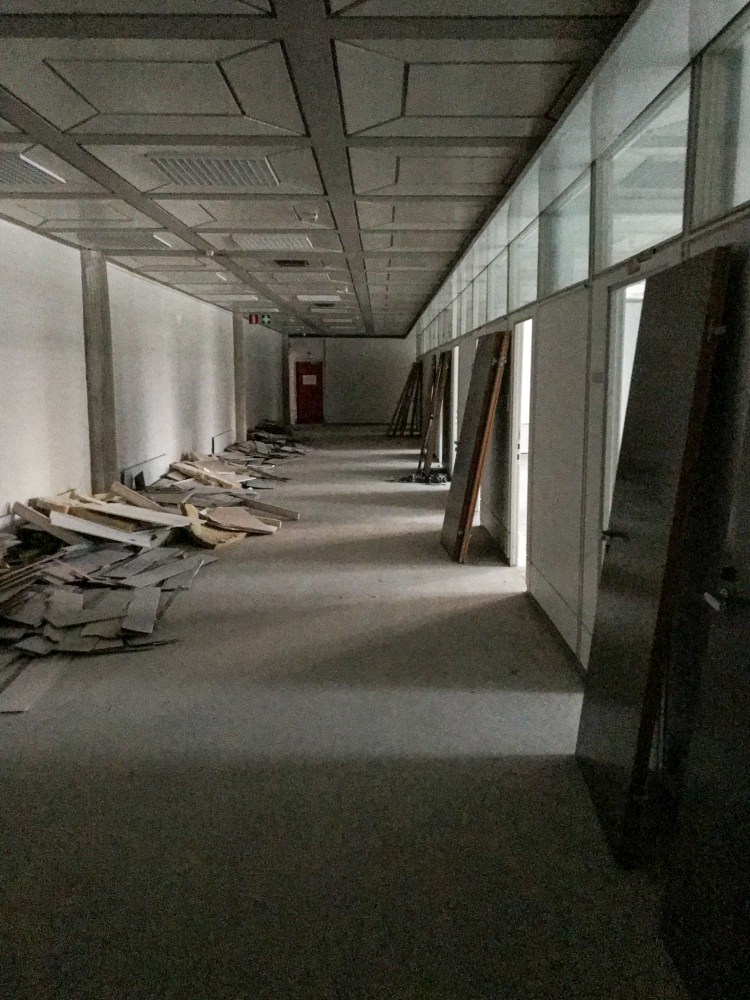
This annex was built in the mid 1980’s and the printing press stood here until 2012. The machines have been removed years ago.

The printing press was operated from the room with the glass windows. Notice, that its outer wall has already been demolished.

This is the former marketing department. The door in the middle of the picture leads directly to the main lobby. All material containing asbestos has been removed including the plastic floor tiles.

Even the red plastic from the stairs is gone.

This is the former editorial office. The air conditioning works a lot better now than in the last days of work here.

Another look at the editorial office. The small particles on the floor are pieces of insulation blown from the mess on the left side of the picture by the wind.

Such a familiar corner. This is where I used to work.

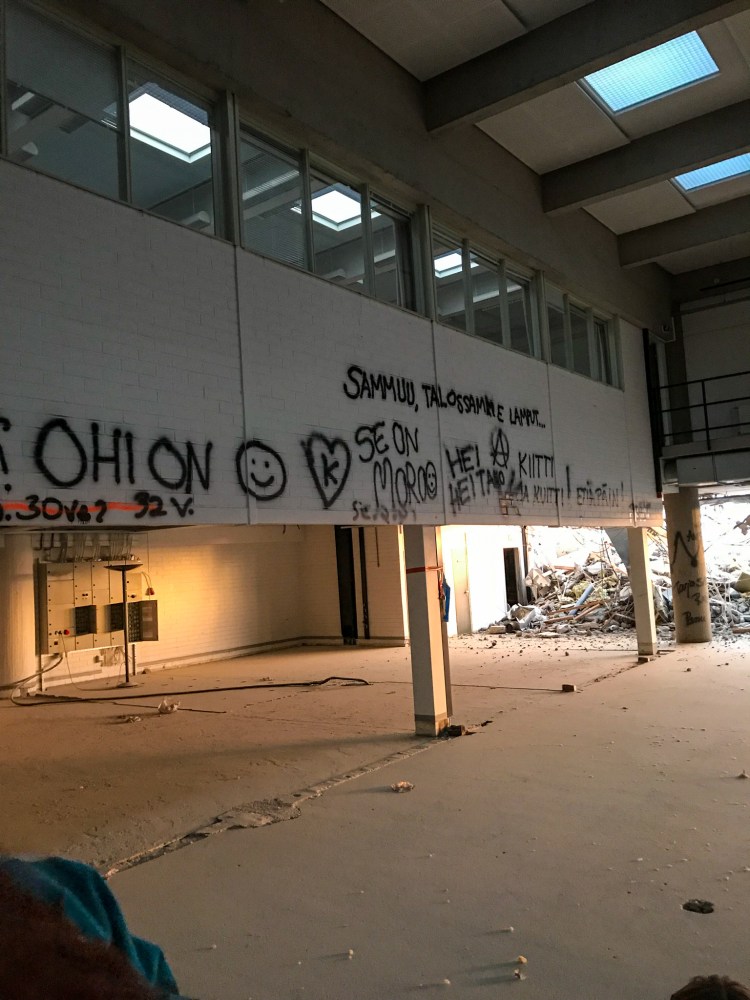
Soon the graffiti made on the last evening will be gone too.

We stayed in the building drinking wine for quite a long time. My friend was the last person to use these toilets.

Let the Destruction Begin

Winter was slowly turning to spring, and believe me, in the North of Finland it really happens slowly. In mid-April we were finally over the worst, and it was no longer completely dark at 9 pm.

I was driving home from my other hobby (yes, I have other hobbies than UE too), when I noticed something was going on with my former workplace.

Demolition had started. They began by destroying what once was the kitchen and canteen and one side of the editorial offices. The rooms to the left missing windows were the former offices of the management on the top floor and the meeting room, where the daily newspaper was planned, on the first floor.

Although I knew this was coming, I was a bit sad. After all, this was where I had spent most of my career so far and where I had progressed in my professional skills a lot.

I decided to return regularly to document the demolition like I did with the old printing house.

The Lights Are On, But Hopefully There’s No One Home

A few days after they started demolishing the old school with the lights still on, I noticed that another well published demolition site had commenced. For years there had been plans to build a hotel in the marketplace of Oulu next to the market hall. The plans had been drawn, yet nothing had happened.

There was an old brick building perhaps from the 1950’s, which would give way to the new hotel. It had previously housed social and environment offices of the city, but was now empty. And one single walk through the marketplace on an ice cold winter evening revealed, that something had finally started to happen.

Signs about demolition beginning, construction fences, excavators. And the lights are on in most of the building. I do not understand what they’re doing. Shouldn’t they cut off electricity before tearing the place down.

This was a strange project anyway. They tore down the buildings, then nothing happened. The city took action, then the foundations were built. Then nothing happened. It’s been around four years now, and the hotel is almost complete. Needless to say, I’d have preferred to see that building stay.

But the strangest thing in all this was, that this was the third abandoned and soon to be demolished building that I photographed in a month. And I had no interest whatsoever to try to get inside. I really had lost my passion.

The Workers’ Institute That Vanished Again

When the workers’ institute moved away from the premises, where I photographed in 2014, 2016 and 2017, it was given new spaces in a former school. Built originally in 1964 as a secondary school and high school, it was enlarged in 1968 and 1972. A curious detail about the building was that it was designed by the same architect, who designed the headquarters of newspaper Kaleva.

I found the building a rather interesting example of 1960’s school architecture, but the city thought otherwise. They needed new apartments, so they started planning a residential area featuring five tall blocks of flats.

The planning process was smooth and the workers’ institute once again had to find new premises. When I noticed that most of the school seemed empty, I knew that the end was near.

I did want to take some last photographs from the place, but when I went closer, I noticed demolition had already started. This picture is almost paradoxal: they are tearing the right side apart, yet there’s still clearly something going on in the building. It’s almost like the case with the old mail truck depot.

And the demolition really wasn’t a cosmetic “let’s just rip off a few wall panels” -style thing. The excavator is on the site, but the lights are on.

The large wing in the center of the picture is the gymnasium, I think. Behind it is the wing being demolished.

The mystery remains. Why did they have the lights on? Was someone still home?

Just Came to See if You Were Still Around

Although I quit photographing and exploring abandoned places after my disappointment with the quality of my photos, I never lost interest towards the world of the abandoned. When I decided to spend the new year in the same city where I made a road trip the previous summer, it was clear where I would go.

The same building, which housed a hotel, restaurant and movie theater, was still standing despite the demolition threat looming over it. The city was drawing a new detail plan, and so far it was unclear, what the officials would propose.

I hoped of course, that it would be preserved. But the fact that I never even thought about finding a way in, was pretty telling about my attitude back then.