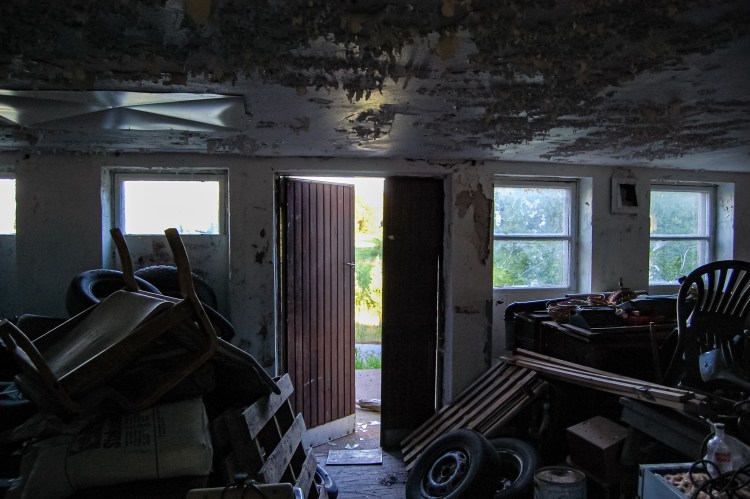
Upstairs we go then. As you can see, it was a very bright spring day outside.
There wasn’t much graffiti downstairs, but upstairs was a different story. I especially like the mad spongebob breaking through the wall. I also wonder, why they had a railway track upstairs and why a wall was built right across it.
While the downstairs was an all open space, the upstairs was much more of a maze.
Here’s the friendly looking gap from my last post pictured from above. The drop actually looks much higher this way.
There has been something big in the corner. What, history isn’t here to tell us that anymore.
The engineer who loved yellow walls had worked upstairs too.
Despite the sunshine outside, there were scary, dark corridors inside. Is it just me, or is the closest pillar completely out of line?
The power station can bee seen through the windows. The two buildings were really close to each other.
For one reason or another this one reminds me of a school toilet. Whatever it was, it’s not in a very good shape right now.
In the middle of the building it was really just empty rooms.
Or not completely empty. This one contained lots of receipt looking paper slips.
About half of the building’s upstairs was completely destroyed by fire. We didn’t want to go any further, as we deemed it unsafe.
Here are some exterior shots of the planing mill.
And here’s anohter. The strange modern doors do make it a bit uglier, but the place used to be a beautiful example of 1920’s industrial architecture.
The planing mill can be seen on the left, the power station is to the right. And that’s where we’ll head next.
In the early 20th century a local railway station manager founded a sawmill in an island in front of a village called Martinniemi some 30 kilometers from the city of Oulu. After years of financial problems, a bancrupcy and several ownership changes, the sawmill got new owners, a fresh start and an expansion. In the early 1920’s a groundwood mill and a power plant with a towering 72 meter chimney were built on another adjacent island a bit away. The huge chimney became the symbol of the village, which quickly grew and developed. A people’s house, stores and blocks of flats were built, Martinniemi thrived.
Several ownership changes took place again. The groundwood mill was closed down in the 60’s. It was converted to a planing mill and the power plant was modernized in the 70’s. In the late 80’s after yet another ownership change, everything was closed down. The village became a quiet suburb with high unemployment, cheap apartments and social problems. The sawmill and most of the buildings in the area got a new lease of life with small entrepreneurs, the power plant and the planing mill were left on their own. Years of court battles between protectionists and the huge forest giant owning the property followed.
Early in 2011 the planing mill caught fire. And a few months later, when I asked my friends, if there was anything to photograph nearby, they took me there.
This was the mess that greeted us, when entering the building, which had stood vacant for almost 25 years. The machinery has been removed, and all that is left are wood splinters.
There were no intact windows, which really didn’t even surprise us. What did surprise us was, what a plastic garden chair was doing in a place like this and why it had decided to hang itself on a pipe.
The roof had really nice and safe looking hatches upstairs. Despite the softish wood splinters on the floor, I really wouldn’t like to fall through that one.
The sign tells to watch out for moving machinery…
…but I really doubt they would pose any danger to me even if they still moved.
Once again we really didn’t have difficulties entering the building as it was all open doors.
Some of the doors were surprisingly modern, though.
This, I take, is the main production space. There’s water on the floor, but the grey, slushy thing between it and the yellow wall is plain ice.
There was a path higher up like the floor was lava. For some reason they wanted their office blocks (or whatever they were) canary yellow.
A view outside through one of the garage doors. Someone had lost their sofa, which had clearly suffered a bad burn out.
There was also some broken machinery outside the planing mill.
Another look inside. There was surprisingly little graffiti around despite the years of neglect.
This one was the only large piece downstairs. But perhaps if we went up, we found some more.
So the time has come for the last post from the abandoned abattoir. At least for now. And it’s time to explore the garage and power station building.
Most of the doors were locked and tightly sealed, so there was no access. Luckily not all of them. Even though the sign tells you to shut the door in two different languages.
Behind the door was a vintage Toyota Corolla. And a real man cave.
So this is where the local boys have spent their weekend fixing their Toyota, reading car magazines. And eating pickled cucumber, as there were cans of it here, too. The dust, however, reveals, that nobody’s been here for ages.
The yard was also littered with all kinds of stuff. The shelter is full of recyled and pressed paper.
There were even two buses parked on the yard completely outgrown by trees. The other one had been partially rebuilt to a transport, the other was a former supermarket on wheels. It was clear, that neither one of them would ever move again.
A view through the bus shows a football field just behind the property. What a nice place to play matches.
Smashed bricks have fallen inside the power station. Whether they have crumbled there on their own or are the result of the partial demolition of the chimney, is unclear to me.
The tower pictured in the setting sun. I really like the architecture of this building, and it’s quite sad to see it in such a horrible state. Almost the whole facade of the building can bee seen here.
So what is this place, and what’s happened with it? After an extensive research, spending 30 euros on ordering official documents and 60 euros on a three month subrscription of the local newspaper, this is, what I have found out:
The bulding was originally built as an abattoir in the late 1940’s. It was the pride and the largest employer of the village in its prime employing more than a hundred people.
In the late 1970’s the company owning it started centering its activities to a nearby town, and in the mid 80’s all production here ended. For some reason or another the logos of the company are still on the facade, and there’s a lot of stuff belonging to it in the attic.
A local food wholesale company bought the premises after this, but it is a bit unclear, when. Some sources say, it was in 1985, but the wholesale company was founded before the late 70’s as its papers from 1975 were in the house. The company register says, this company went bankrupt in 1991. In addition to the abattoir memorabilia, a lot of the wholesale company’s documents can still be found scattered around the building.
What happened after this is a bit unclear. According to the official documents the current owner bought the place in 1993, and the place has stood abandoned around ever since. In my memories it has always been deserted, yet there are letters, newspapers and documents dating back to the late 90’s and early 2000’s in the apartments. Who has brought them here, if not the inhabitants, is unclear to me.
By the time of our visit the owner started having problems with the authorities. The building authorities wanted him to demolish a part of the crumbling chimney they deemed dangerous, which he did. The fire department wanted to conduct a search in the buildings to see, if there was still ammonia in the cooling machines used by the bankrupt food wholesale company, as they suspected. The owner refused to let them in. The neighbours had started complaining. They were concerned about the collapsing chimney and the increasing vandalism on the property.
It was clear, the sun had started to set on this beautiful building. I’m not quite done with its story yet, but now we’ll move on to other places.
All the photos from this location can be viewed in the gallery.
Out we are again. The stairs and the platform next to the low wing part were all covered in glass.
Down in the basement we go. This part of it had natural light coming in, and contained sinks and showers. This is apparently, where the butchers had washed themselves after a long day of hard work.
After that they went to the locker room to change. These lockers seem very different than those stored in the wing of the building. I believe these to be original ones and the others to have been brought here later by someone.
There were even name tags left on some of the lockers. I hope this person lived a good life since the abattoir closed.
The basement continued far below the building, but it was quite a maze and it was pitch dark. Somehow the corridor led to the mouldy room described in the first post, I think. We didn’t follow it furter, and went back up instead.
Behind the open door in the middle of the picture was a large storage room filled with bags of pig fodder and empty boxes with shrimp. There was also a small office space containing the railway map of Finland and again numerous folders of the bankrupt food wholesale company. It turned out the company had shipped huge amounts of shirmp to one of the largest hotels in the area by train. But that was years ago. There was another door to the left.
And behind it was yet another stunning view of approximatly anything you can think of. Boxes, furniture, clothes, bikes… Once again we were pretty amazed.
A view of the same room taken from the other direction. Things have just been brought here. I had to google Distrimex out of curiosity. It’s a major supplier of fresh food and vegetables. You can also see containers of some less fresh vegetables next to the pillar.
This room was in the front of the building right next to the facade. There was another small office space, more furniture, boxes and several fridges. They looked like they were from a supermarket, but this place surely hadn’t been a supermarket.
There weer several big cold rooms. In here there was yet another bike, loads of boxes and pig fodder. Apparently the cold room was full of pig fodder, too.
The sun was going down very beautifully, as we exited the main building.
Here’s one more look up the tower in the evening sun. During daytime the building actually looks quite beautiful.
Time to see, what the power station and garage had to offer. But that’s for the next and last post from this place for now to find out.
Back down we go then. As the third floor had been all about apartments, I expected to find them on the second floor, too. This, however, proved not to be the case.
What we found instead was an office space full of documents belonging to a company which had operated in the building after the abattoir had closed down. There were dozens of shelves apparently containing lots of sales and financial information just left there for anyone to browse through.
In addition to the files there was art. Several paintings. Either they had been somewhere in the building or brought in later by the mysterious collector, who had filled the place with all kinds of stuff.
There was a large glass wall separating the offices from the corridor. Behind you can see yet another shelf with archive files and a toilet. There was also a bathroom with a tub and…
… a vault. Judging by the location of other walls, there is a full room behind that door. What’s in it, a gold treasure or just some rotten archives, we will never know.
But the next room houses yet again a major surprise. The whole floor was covered in bags of clothes, which had been ripped open. The sea of old fabric was knee high. These had definitely been brought here by someone.
Behind the office was access to the attic above the low wing of the building. The photos I took there failed pretty miserably, but there was a collection of stuff from the time the abattoir operated in the building – commercials, recipe leaflets and even large, heavy blocks with the abattoir’s logo on them.
Seeing this makes me try to recall, when was the last time I drank bulk beer from a bottle. They sell it all in cans now.
On the second floor was another balcony. This time they hadn’t smashed the door, only the glass.
There was also an apartment on the second floor. I still don’t know, what’s on the walls. If you once again take a look at the picture taken on my first visit more than a year earlier, almost everything is as it was. The only thing that has been moved is the red canister, which has mysteriously travelled 15 centimetres to the left. This could go well down as a pair of spot five differences pictures.
There was a beautiful and pretty original looking fireplace in the living room.
There was also quite a mess. The third floor had all in all escaped devastation much better than the second floor. Maybe the vandals were lazy.
I particularly like this picture because of how the light comes in. I didn’t touch the boxes, they were like that from the beginning.
Such fine curtains. You could well imagine a princess bed beneath them rather than the dirty mattress.
This post ends with a close up of the stove in the second floor apartment. In the next post we’ll take a look at the basement (yikes)
The first thing I found on the third floor was this kitchen, which was designed with incredibly bad taste. The red and green really don’t go well together, and to make matters worse someone had decided, that attaching lace to the kitchen counter was a good idea. Ugh.
Behind the kitchen was a small room, where it looked like someone had started renovations. Probably it had more to do with someone initiating destruction.
This room, like all the others, was littered with all kinds of random stuff. Someone had forgotten their jacket.
The following room was almost intact. It looked as if the inhabitants had just left. The rug on the wall was pretty spectacular, although I wouldn’t hang anything like that on my own walls.
A view from the other side of the same room. As you can see, the nearest neighbours are not that far away. The hole looking thing next to the radiator really is a hole someone has carved there.
Although the place clearly has been abandoned for years, there were surprisingly little graffiti and other tags on the walls. This one says “hey man, this is my home”.
Someone had been pretty desperate in getting to the balcony and smashed everything in the process.
The inner balcony door was still intact, although badly worn. Apparently all the doors and window frames had originally been red, but the balcony doors had been painted white at some stage.
There were two doors from the hallway on the third floor. One led to the apartment, which we just visited, the other one led deeper into the building. It was almost impossible to walk through it, as there were boxes of old newspapers and commercials blocking it. The pile of paper was waist high, but we managed to get through. In the other end we found two more apartments.
Again the last inhabitants had left their stuff behind. I’m not really sure the huge white containers were theirs, unless they were really big fans of mead. Or kilju.
I said earlier, that I really didn’t want to run into living creatures while visiting abandoned houses. I certainly didn’t expect to meet this chap. I’m not a biologist, but I think that’s a small tortoiseshell over there.
The kitchen of the second apartment on the third floor. The same mess was evident here, like in all the other places.
The living room of the third floor apartment. This area of the building had survived all vandalism, perhaps because it was so difficult to get through the mess in the corridor. The strange thing about this place was, that there was a kitchen, chairs, sofa and even a table, but no bed.
A look towards the entrance of the apartment. The door at the back leads to the butterfly’s home.
We crawled back through the cramped corridor and back to the main stairway. Here’s another look at the tower and its leaky roof before we started our journey down the stairs.
I have already reached the door. It wasn’t exactly difficult to get this far, as all doors so far had been wide open. I had previously been too afraid to even get to this point, now I was feeling just fine. And I was about to enter, for the first time in daylight.
Like I remembered, it was a mess. For the first time I could now see the faded, old magazines and commercials, which had scared me so much during my last visit more than a year ago. And when you compare the next two pictures to the ones behind the link, you notice, that not much has changed since then.
The pink walls, the fridge and even the cardboard boxes had hardly moved. Someone had brought their mattress, though.
Even the paper sheets on the window board were untouched.
Is it just me, or was everything done more beautifully back in the old days? I mean, those heaters and handrails are all very basic and probably the cheapest they could find. And yet they look much better than modern ones.
The higher we climbed, the more uneasing things we found. There were several cans and bottles left on window boards, and they all had expiry dates long in the future.
It was certain, that there were regular visitors there. At first I judged everything by the mattresses and beds everywhere, and thought maybe someone homeless lived there. But then I remembered I was in a very small village, and there usually aren’t homeless people in those. I guessed that the people drinking in here were the same people, who smashed all the doors and windows in the house. And I really didn’t want to meet them.
This made me feel even more uneasy, and I don’t mean the fact that nobody had washed the windows in decades or something. If that is not made by a bullet, then what is it? And I really didn’t want to run into someone, who was drunk and carrying a gun in an abandoned abattoir.
The use of this pipe was a little unclear for me, as it was placed directly above stairs and too high to reach. If it was meant for a fire emergency, the crew would have needed stairs of their own to use it. So maybe it was for washing the stairs or then it was installed for Kevin McCallister’s Finnish counterparts to spray sludge on unsuspecting explorers.
When I visit abandoned houses, I take a very methodical approach to exploring them. I start from one end and make my way to the other making sure not to miss a single unlocked room..
After leaving the low wing of the old abattoir, we headed towards the main building, which I had already once visited.
A look back towards the direction we had entered the building from. It was supposed to be white, but its skin was peeling.
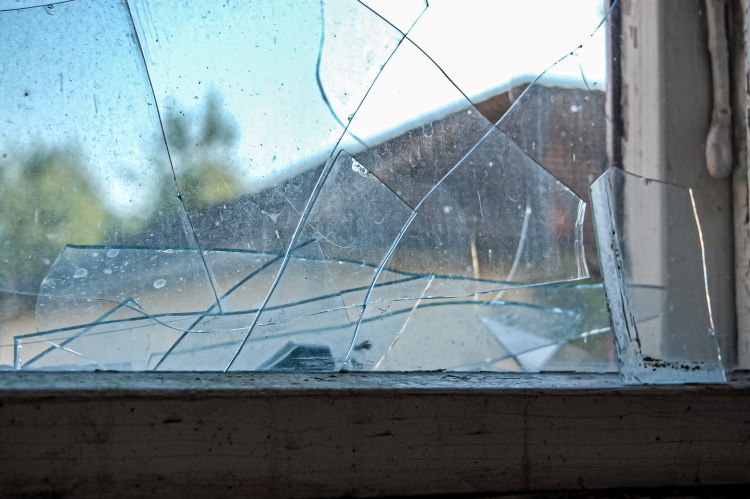
Several Windows were broken. This one looks like it has been smashed by a loose piece of the wall.
There was even a basement, but I chose not to enter. There are no good photos of it, but eveything, absolutely everything there was covered in a thick layer of mould.
Looks like an unsuspecting explorer might get hit with a chunk of wall anytime soon.
I have no idea, what the walls are growing, as plants are not my strong side. I’m not an electrician, either, but I hope for the sake of everybody’s safety, that those cables are disconnected.
The rear side of the building is slowly turning to a forest. And the variety of things stored at the property doesn’t limit to the interior. Let’s take a closer look at that wooden frame, as it seems pretty familiar.
This is the frame of a shelter building for fur animals. What it is doing here, is very unclear to me, as fur farming has nothing to do with this abattoir. Hopefully.
Something in the place was just dreamlike. Maybe it was the odd contrast between the wildly growing plants and the functionalistic architecture of the building.
Or the evening sun flickering on the walls.
This is why I love this particular style of architecture. The lines are simple, clean and symmetric. The room behind the windows is the one with all the miscellaneous stuff described in the first interior shot of the building. Below it is the basement we didn’t enter. I did take a picture through the broken window, however.
Inside was yet another surprise. Broken bathroom appliances covered in years of dust. We couldn’t find a place in the building, where these could have come from, so they must have been specifically brought here.
Finally we were on the front side of the building. This is not a part of the main complex, but rather a separate building housing garages and the boiler room. The chimney was originally taller, but the authroities ordered the owner to chop up some of it because it was in danger of collapsing.
Here’s most of the main building as seen from the large yard. As you can see, it is huge and quite a maze. The tower is the part I visited in the middle of the night a year earlier, the wing on the right is the part already shown in the previous post.
Here I am again, standing on the scene of my very worst nightmares. But this time I’m not afraid at all of going in.
More than a year had passed since my drunken nightly visit to the abattoir I was so afraid of. After the visit my nightmares abruptly stopped and the fear was completely gone.
I told my colleague about the abattoir, the visit and my desire to further explore the place during daylight hours. She told me she had worked for a local museum and one of her duties was to document old houses, so she was used to roaming in abandoned houses. I happily accepted her as my company.
We set our course towards the place on a beautiful, warm summer evening, when the world wasn’t the least bit scary…
This time we decided to get in through the back door. I had never been here in the summer, and hadn’t realized, how nature had taken the whole place over.
It really wasn’t too difficult to find open doors. In fact I think there were more unlocked than locked doors in the whole building.
This is always the most exciting part. You have absolutely no idea, what you are going to face next. I can’t remember what I was expecting, but I certainly didn’t expect this…
The variety of stuff stored in the wing building was greater than on an average flea market. There was literally everything from toys and typewriters to furniture and skis. The bags on the right contain pig fodder.
No matter where you looked or went, every corner was full of stuff. This one was the local tire hotel.
More tires, served with motor oil and pickled cucumber.
Featuring bikes, banana boxes, carpets and a bag of floor plaster.
One room was filled with cupboards and lockers of various shapes and sizes. One of them looked like it had suffered a fire.
The evening light in the rooms was extremely beautiful. Judging by the white tiled walls and concrete floor, this was the area, where the animals were slaughtered.
A closeup of a locker door. Judging by the dates this one has rested here for quite some time.
Next to the burned cupboards was a mix of fridges, empty food boxes and doors.
This area of the building was isolated from the others. Either there was no route to the three-storey wing of the building, it had been shut, or it was just blocked with all the junk inside. We had to go back and find another route to continue our exploration.
It had now been more than two years since I saw the abattoir, which sparked my interest towards abandoned buildings. I had tried entering it numerous times, but it came to nothing. I drove to the village, parked my car and walked the last hundred meters just to freeze from fear at the gates.
At this time my mental health was in an awful condition. I was battling difficult depression, had lost all self confidence and spent my days drinking beer in my bed buried in suicidal thoughts. When I finally fell asleep, it was all nightmares. In them I lost my friends, their loved ones hated them or they were killed, just because of my mistakes or inability to keep their secrets. Every night the catastrophes were different, but all dreams ended in the same way. It was afternoon and still light outside, and I had destroyed everything. I started running from my hometown. I ran and I ran and I ran, until it was dark and I was in the tiny village and stood on stairs in front of two doors. I slowly looked up and saw a white tower, and was so afraid, I was unable to move. I woke up, it was in the middle of the night and I was panicking.
I told my friends about my struggles with the abattoir, and they encouraged me to enter. They even joined me on my journeys to the village, but I just couldn’t overcome my fear. I was still left at the gates.
One night my friend had had enough. She knocked my door with three bottles of wine. She told me to drink until I had the courage to enter, and offered to drive me there, once I was drunk enough. After two hours and one bottle I said I was ready to go.
We drove an hour through the darkness and parked the car a few hundred meters away. She promised to join me on my exploration, but there was one obstacle too much for her. Just before the abattoir is a railroad overpass. Whenever a train has just passed or is about to pass, the bridge makes really strange hissing sounds, and the night train had just gone, so the bridge was pretty loud. My friend was afraid, so she decided to return to the car.
I was alone in the dark and extremely afraid. For one reason or another I started running, and ran through the gates. It had been snowing that day, but there was a clear path of fresh footprints from the gate, so someone else had been there recently. I followed the footprints and turned left behind the building. There I found this.
I had run straight to the scene of my nightmares. There I was standing on the stairs in front of two doors slowly looking up towards the tower, and I was grossly unprepared. It was pitch dark, and I only had a mobile phone without a flashlight and a small camera with me. I pulled the door handle and kept telling myself “please don’t open, please don’t open”. At first it seemed that my prayers were heard, but when I yanked the door a bit harder, it opened.
I stepped inside into complete darkness. I was so afraid, the only sounds I could hear were the blood rushing through my veins and my own heartbeat. It was completely dark, and to see something, I tried to use the camera flash.
I had entered a small space just about a meter long. Its floor was covered in old newspapers and commercials, and I was faced with two old wooden doors. I had to push them open really hard, as the floor was covered in paper even on the other side. Once I was through it, it smashed shut behind me with such a loud bang, that I thought I had woken up the whole village. Now I needed another picture to see, where I was going.
Tempting pink walls and more trash was awaiting me, as I slowly made my way up by the feel of the handrail. Every time I heard the sound of my feet hitting the paper on the floor, I startled a little.
I took more photos as I found my way higher up. The paper piles ended, but now there was shattered glass everywhere.
This was the second floor. More pink walls, thrash and steam from my breath – it was quite a cold night.
The third floor. This was as high as you could climb. I thought it would be a good idea to check one of the rooms here.
Pretty much the same as in the stairway. Trash and dirt.
The deeper I went, the more chaotic the place became. Someone had apparently tried to clean things up, but given up hope. And what on earth is that on the walls?
I also took one photo of the tower through the hatch in the roof. This was, what I was so afraid of as a child: a leaky roof, stairs, some wood and a water tank on the other side.
By now I felt complete inner peace. I sat down on the top of the stairs, went on with my second bottle of wine, and just sat there. When the blood rush and my heartbeat calmed down, I noticed, it was very quiet. I just sat and sat and never wanted out.
After 45 minutes my friend called me asking, if I was still alive.
“Do you realize, you have sat inside an abandoned abattoir for 45 minutes? Get the hell out of there”, she screamed, and I suddenly realized, where I was. I ran out, ran to the car, and we drove home in complete silence. I had overcome my fears. And I surely would come back.
Cookie Consent
We use cookies to improve your experience on our site. By using our site, you consent to cookies.
Websites store cookies to enhance functionality and personalise your experience. You can manage your preferences, but blocking some cookies may impact site performance and services.
Essential cookies enable basic functions and are necessary for the proper function of the website.
Name
Description
Duration
Cookie Preferences
This cookie is used to store the user's cookie consent preferences.